Is Your Jaw Affecting Your Entire Body?
The surprising connection between your jaw, nervous system, and chronic tension.
Many people think of the jaw only when they have dental work or TMJ pain. But what if your jaw is quietly influencing headaches, neck pain, shoulder tension, posture, and even how your nervous system functions?
As a craniosacral therapist, I often see that the body doesn't work in isolated pieces. Everything is connected, and the jaw is one of the most fascinating examples of that.
Your Jaw Rarely Works Alone
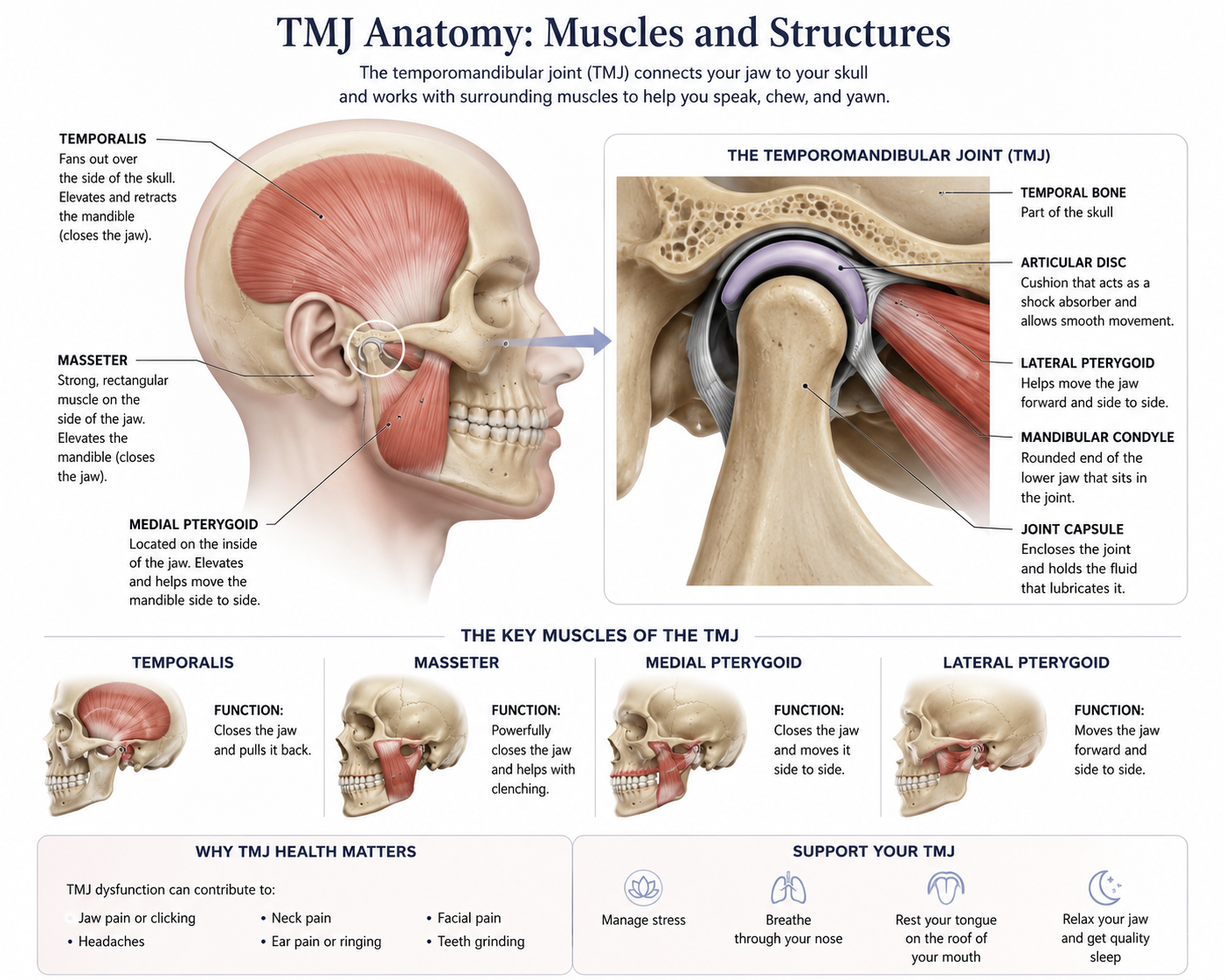
The muscles of your jaw are intimately connected with the muscles of your head, neck, face, diaphragm, and pelvic floor through complex fascial and neurological relationships.
When your jaw is under constant tension, whether from clenching, grinding, stress, or compensating for the way your teeth meet, that tension doesn't simply stay in your face.
It often spreads.
Some people experience:
Morning jaw soreness
Frequent headaches
Neck stiffness
Tight shoulders
Ear pain or ringing
Facial pain
Reduced ability to fully relax
The body is remarkably adaptive. If one area isn't functioning efficiently, another area often compensates.
Why Do We Clench Our Teeth?
There isn't one single answer.
For some people, nighttime clenching is primarily driven by stress and nervous system activation.
For others, the way the teeth come together or the position of the jaw may contribute.
Some practitioners also believe that tongue posture and nasal breathing play a role in helping the jaw find a comfortable resting position, although research in this area is still evolving.
Most likely, these factors exist on a spectrum rather than having one universal cause.
The Nervous System's Role
One of the biggest contributors I see isn't necessarily the jaw itself.
It's the nervous system.
When we're living in chronic stress, our bodies often stay prepared for action, even while we're sleeping.
The jaw is one of the first places many people store this tension.
Think about the expressions:
"Bite your tongue."
"Grit your teeth."
"Hold it together."
Our language reflects what our bodies often do.
The muscles never quite receive the message that they're safe enough to let go.
Why Craniosacral Therapy Can Help
Rather than forcing muscles to relax, craniosacral therapy works by encouraging the nervous system to shift out of its protective patterns.
As the nervous system becomes more regulated, the tissues throughout the head, jaw, neck, and body often begin to soften naturally.
Many clients report improvements in:
Jaw tension
Headaches
Neck mobility
Sleep quality
Overall sense of calm
Every person is different, but addressing the jaw through the lens of the whole body often produces much more meaningful changes than treating the jaw in isolation.
A Whole-Body Perspective
Your jaw isn't just a hinge that opens and closes.
It's part of an incredibly intelligent system that includes your breathing, posture, fascia, nervous system, and emotional wellbeing.
Sometimes the jaw is the source of the problem.
Sometimes it's simply telling the story of stress that's being held elsewhere.
Either way, listening to what your body is communicating can be the first step toward lasting change.
Curious whether your jaw could be affecting the rest of your body?
If you're experiencing chronic jaw tension, headaches, neck pain, or feel like your body never fully relaxes, craniosacral therapy offers a gentle, whole-body approach to uncovering the underlying patterns.
You were never meant to spend your life simply managing symptoms. Your body is always working to move toward health; it just sometimes needs the right environment to do so. Craniosacral Therapy creates that environment. If you're ready to stop chasing symptoms and start addressing the deeper patterns beneath them, schedule your session today. Your healing journey begins with a single conversation.