Learning to Listen to the Wave
Surfing, Craniosacral Rhythm & the Intelligence of the Body
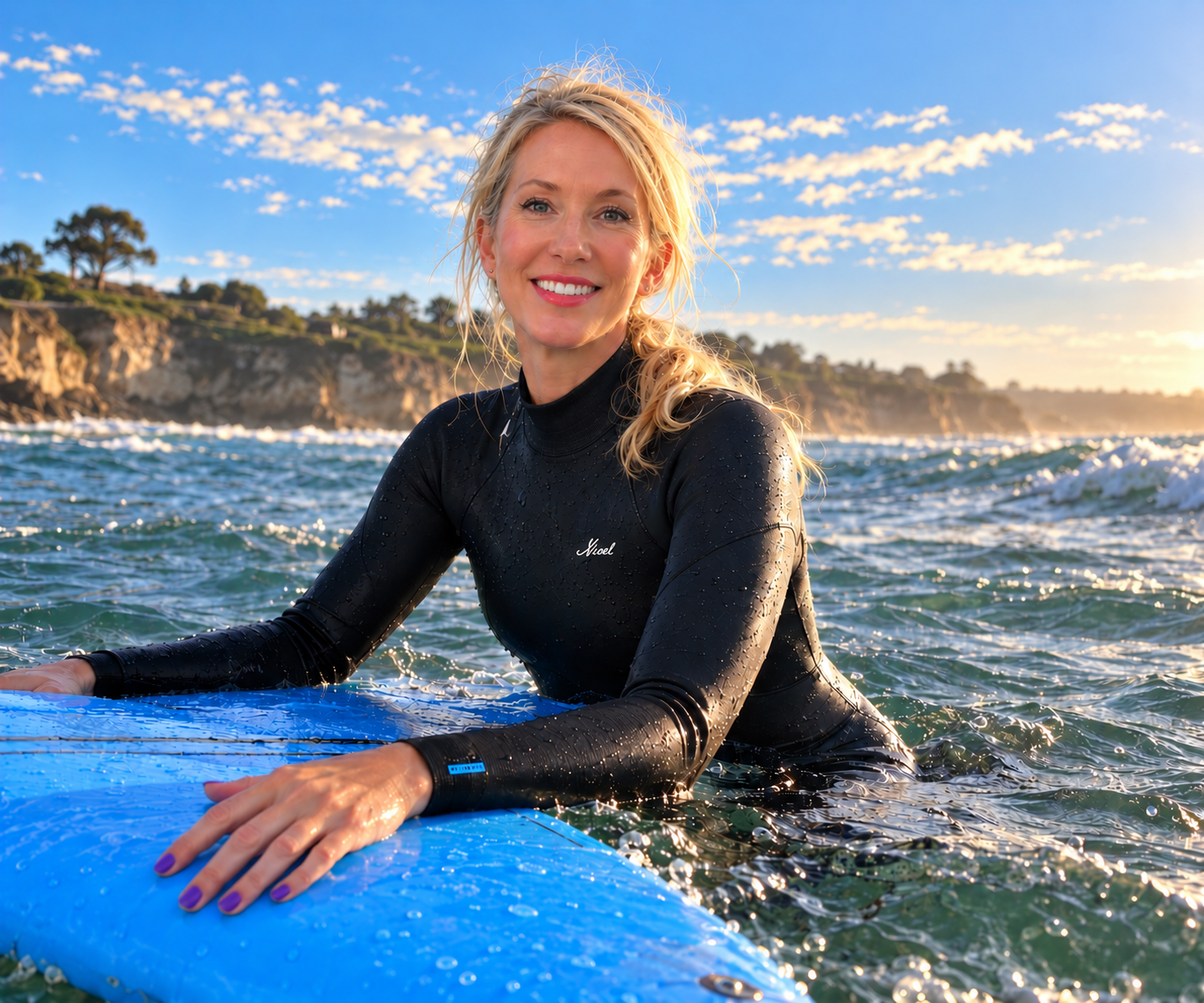
There are some things the body understands before the mind ever finds words for them.
Recently, I found myself sitting on a surfboard in the Pacific Ocean, waiting for a wave.
And waiting.
And waiting some more.
For someone who has spent years working with subtle rhythms in the body, I was amused by how quickly the ocean began teaching me a very familiar lesson:
You cannot force a rhythm. You have to learn how to listen to it.
From the shore, surfing looks like a sport of action. You paddle. You stand. You balance. You ride.
But being in the water feels completely different.
There is so much listening involved.
You watch the horizon. You feel the water moving underneath you. You notice one swell pass and another begin to build behind it. You learn where to position yourself. You paddle when the moment comes.
But ultimately, you don't create the wave.
You meet it.
And somewhere out there, bobbing around in the Pacific, I thought:
Oh. I know this.
This is so much of what I have learned through craniosacral work.
The Body Has Its Own Timing
When I place my hands on someone during a craniosacral session, I am not approaching their body as something I need to overpower or correct.
I am listening.
The human body is never truly still.
Breath moves through it. The heart pulses. Fluids shift. Fascia transmits tension and movement. The nervous system is continuously receiving information from both inside and outside the body and adapting in response.
There are layers upon layers of rhythm.
With experience, the hands become sensitive to subtle changes in movement, tension and ease.
And rather than immediately asking, What can I make happen here? I find myself asking something very different:
What is this body already trying to do?
That question changes everything.
You Can't Paddle Hard Enough to Create a Wave
Surfing gives you immediate feedback about effort.
You can paddle furiously after the wrong wave and exhaust yourself.
You can mistime the right one.
Or you can feel something building beneath you, position yourself well, paddle at the right moment, and suddenly the ocean does most of the work.
There is a point when effort becomes cooperation.
I think bodies can be like this too.
More pressure is not always more effective. More intervention is not necessarily more therapeutic. Sometimes meaningful change happens when we stop demanding that the body respond according to our timetable and give it enough support to reveal its own.
That doesn't mean doing nothing.
A surfer isn't passive.
She is paying exquisite attention.
She is orienting, sensing, responding, and adjusting constantly.
She is doing all of that in relationship with something larger than herself.
The Body as an Intelligent Perceptual System
This idea has become increasingly important in the way I understand my work:
The body is an intelligent perceptual system.
We often think of perception as something that happens primarily in the brain, while overlooking how deeply the body itself participates in sensing and responding to the world.
But your body is perceiving your world all the time.
Gravity. Pressure. Temperature. Movement. Balance. Internal sensation. Touch. Safety. Connection.
In the ocean, this becomes beautifully obvious.
Your vestibular system is orienting you to movement and gravity. Your eyes are tracking the horizon. Your joints and muscles are constantly adjusting to instability. Your nervous system is processing enormous amounts of sensory information before your conscious mind could possibly narrate all of it.
And then something remarkable happens.
For a moment, you stop thinking about every individual movement.
Your body begins to know.
There is an intelligence available to us that doesn't always arrive through thought.
Sometimes it arrives through sensation.
Regulation Isn't Stillness
Maybe this was my favorite realization of all.
We often imagine regulation as calmness.
Stillness.
A perfectly quiet nervous system.
But look at the ocean.
It is profoundly rhythmic, and almost never still.
A healthy nervous system isn't one that remains calm all the time either. It has range. It can mobilize when something requires action and settle when the demand has passed. It can move between effort and rest, expansion and contraction, engagement and release.
Perhaps regulation is not about making our internal ocean perfectly flat.
Perhaps it is about developing the capacity to move with what comes without losing ourselves inside it.
And Then There Is the Pause
Some of the most beautiful moments in surfing happen between waves.
You're simply sitting there.
Floating.
Breathing.
Watching the horizon.
From the outside, it might look like absolutely nothing is happening.
But you're listening.
There are moments during craniosacral work that feel remarkably similar.
Everything becomes quiet.
My hands become still.
Breathing may change.
Tension softens somewhere.
Awareness shifts.
And what looks like nothing from the outside can be a very alive moment inside the system.
I've learned not to rush those moments.
The ocean reminded me why.
The pause is part of the rhythm too.
Learning to Listen
I went surfing because I wanted to experience something new.
I didn't expect the ocean to reflect something I have spent years learning with my hands.
But perhaps that's why the experience stayed with me.
The ocean doesn't respond to force.
And neither does the body always respond the way we think it should.
Both ask something subtler of us:
Attention.
Patience.
Curiosity.
Humility.
The willingness to feel before acting.
And the discernment to know when it's time to move.
Maybe healing isn't always about trying harder to change ourselves.
Maybe sometimes it begins by becoming quiet enough to recognize the movement that is already there.
The ocean has rhythm.
The body has rhythm.
And there is wisdom in learning how to listen to both.
— Darcy Perdue
Craniosacral Therapy Reno